

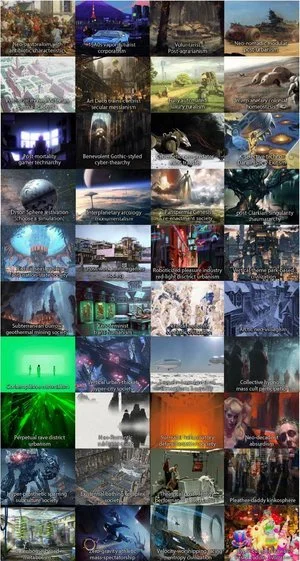








The following are my lecture notes for my 21st century history course (which I most recently taught in the spring semester of the 2112-2113 academic year), delving into the fact that the present is quite different from some of the past visions of the future (which is now the present).
“Need I recall that Whitman wrote an apostrophe to the locomotive, that Emerson said a steamship sailing promptly between America and Europe might be as beautiful as a star, and that Thoreau, who loved to hear the wind in the pine needles, listened with equal pleasure to the music of the telegraph wires?” Lewis Mumford, The Golden Day (1926), 277.Never take the present shape of things for granted. That the present looks the way it does was never a guaranteed outcome in the past. As Walter Benjamin wrote (a third of the way through the twentieth century), the “angel of history” flies backwards into the future, “[h]is face . . . turned toward the past. Where we perceive a chain of events, he sees one single catastrophe which keeps piling wreckage upon wreckage.” History is this “pile of debris [which] grows skyward,” while the angel is propelled forward on a storm that “we call progress.” Cities, of course, are archives: layered, curated, selectively-preserved, bricolage piles of debris reaching skyward. And I think we need to think of them like this. What we have today is the result of a series of cultural attitudes, incentive structures, and aesthetic preferences that allow us to curate, design, assess, and selectively eliminate elements within the built environment. That today’s cities would be an “urban thicket”—a dense, multi-layered, vertically-oriented, tangibly complex, 3-dimensionally-navigable, labyrinthine, rhizomatic, aesthetically-diverse, multi-use, energetic interweave of structures and infrastructures—was not even conceivable outside of dystopian fiction 100 years ago. And yet, this vision, as I hope to show, came to displace a competing, sterile vision of the future city that fetishized open space, greenery, and sleek, simple geometries.
“All cities are geological,” the Situationists conveyed in 1953. There is something quite sedimentary about urban conglomerations. The additions and subtractions made to the city testify to the choices of every era. The twentieth century, during which time Benjamin was writing, made most of its additions outwards. But in the second half of the last century, as you know, much of our development has been vertical. The spatial footprint of our cities has actually shrunk—something that Iannis Xenakis predicted in “The Cosmic City,” when he speculated that “[t]he liberation of the ground and the technical advances of such a city will result in the recovery of vast stretches of land.” In fact, the majority of our greenhouse farms, algae pools, and solar collectors stand upon the foundations of suburban houses and shopping centers that once served as the primary domiciles and material depots for people living in developed countries during that troubled century. While some suburbs still stand, most were too impractical to salvage, since their low density did not lend itself to municipal climate control or to rapid transit. In a changing climate, with its extreme weather, variable air quality, and rising infrastructure costs, the suburbs declined into highly stratified slums and ethnicized survivalist enclaves—a situation that was largely mitigated by the Great Buyout. Many of the wild, untamed jungles and forests that stand right at the edges of our cities today were also previously farms and ranches that were no longer needed when we switched to synthetic proteins. Where it used to take hours to reach this kind of wilderness from the center of cities, it now simply requires crossing a bridge, tunnel or outer transit ring.
If the sprawling suburbs and exurbs were clearly acknowledged to be deleterious by midcentury, at the beginning of the last century, when our society was just beginning to reckon with the ecological and cultural crises that horizontal development had wrought, our contemporary, vertical way of life was far from obvious to most people. The future people imagined then was very different from what we, in actuality, have now. As theorists and historians of temporality from that time knew (people like Mark Fisher and Reinhart Koselleck), imagining the future from inside of the present always runs the risk of reflexively reproducing the status quo, with its limited aspirations and limiting anxieties. And yet, the most prolific vision of the future at that time was extremely neurotic, sterile, and isolating. Most depictions of futuristic cities fell into one of two basic categories—what I will call, for simplicity, white cities and noir cities. If you were to search, in their barbarically distracting and advertisement-strewn version of the Internet, for pictures of a “futuristic city,” you would see this clear taxonomic dichotomy. White cities were nearly always rendered as wholesome, sunny, orderly, highly formalistic places with spaced-apart, sculptural, and nearly always white buildings with generous green spaces between them (often with vegetation spilling out of the buildings). Noir cities were the alter-ego of these: dark, hyper-dense, chaotic, neon-illuminated cities that are almost always depicted at night, in the rain. Typically, the former was associated with more-or-less optimistic renditions of the future, whereas the latter was associated with dystopian renditions. Correspondingly, the former was the go-to aesthetic of the optimistic “solarpunk” genre (which of course prefigured the contemporary ecological ethos), whereas the latter was the go-to aesthetic of the dystopian cyberpunk genre (which of course prefigured the contemporary aesthetic and trans-humanist cultural pathos).
Both visions of the future were rooted in nineteenth and twentieth-century ideas and concerns about the city: the noir city was an echo of the overcrowded, unhealthy, polluted industrial city that shocked and horrified middle-class Progressive reformers (which spurred the outward development of the ensuing century), whereas the white city was an echo of its supposed remedy: the neoclassical “City Beautiful” ideal and the garden city suburb—with shimmering towers replacing the cul-de-sac (with no less isolation or sterility).
It would be difficult to overstate the white city’s grip on our culture’s collective imagination about what a desirable future urbanism should be like. White cities were the suburbanite’s idea of the future. Their big, open green spaces, landscaped parks, gardens, and urban forests between buildings evoke the sprawling suburban golf course communities of the then-contemporary world. A central flaw of the white city was its obsession with bringing “nature into the city,” which led to a fetishistic amount of ground-level green space—clearly a residual holdover from a time in which urban planning was tasked with bringing light, air and views into the polluted slums of nineteenth-century industrializing cities (remember: they still used combustion for heat and propulsion at the time!).
Karl Marx warned us, well over two hundred years ago, how difficult it is to imagine new things; that “[t]radition from all the dead generations weighs like a nightmare on the brain of the living. And just when they appear to be revolutionizing themselves and their circumstances, in creating something unprecedented, in just such epochs of revolutionary crisis, that is when they nervously summon up the spirits of the past, borrowing from them their names, marching orders, uniforms, in order to enact new scenes in world history, but in this time-honored guise and with this borrowed language.” Likewise, Frederic Jameson wrote in the 1980s about our “constitutional inability” to imagine structurally different futures (in this case, utopias), caused by “the systemic, cultural, and ideological closure of which we are all prisoners.” It was, correspondingly, impossible for previous generations to imagine the form or the content of our current society; it appeared to them in fragmentary forms, in both their dreams, and, incredibly, in the dark, mysterious murk of their nightmares.
The white city vision that was once considered to be cutting edge was merely a vertical suburb. Its vision of life was merely a blend of luxury consumption, “voluntary primitivism” (itself a reaction to modernization), and refined middle class temperance. As a result, despite the height of its pointy buildings, the white city they imagined was a 2-dimensional, desolate place—a landscaped “drosscape” whose buildings stand alone like temples to their own vanity. Because of their spacing and shape (usually wide at the bottom and pointy at the top), the buildings failed to create any sort of vibrancy or shelter at the ground level. This vision of the city’s simple, geometrical open-plan layout (which seems to be a spatialized metaphor for transparency and order) was a fundamentally sterile and monocultural non-place. As the imagined schemes of such cities demonstrate, all structures and infrastructures were smooth and streamlined, knowable and predictable. Like the Jetsons (which was a popular cartoon from the late twentieth century), these schemes left social configurations and aesthetic and cultural institutions untouched. The white city was implicitly a place for wholesome, rich, bourgeois families with a taste for then-fashionable electronic products (such as those manufactured by a company called Apple) and designer eco-furniture—perhaps best depicted in the scenery of the 2013 movie Her (which was admittedly ahead of its time in predicting human-AI intimacy). In a truly devastating development, so-called “luxury” condo developers actually began to build instances of the white city in rich, “gentrified” areas of established cities like New York, London, and San Francisco, and perhaps most egregiously in places like Dubai and Abu Dhabi.These devastatingly expensive vertical suburbs continued to be congested with automobile traffic, plagued with isolation, and crippled by stunning inequality and injustice.
By contrast, despite the dystopian societies that the noir city was imagined to be a symptom of, the category actually offered a formula for urban life that was far more compelling and sophisticated than that offered by the white city. Perhaps the most compelling thing about the noir city was its complex, layered hyper-density—the “urban thicket”—a condition that, as we know now, is truly desirable, and to be sought after. As the then-popular cyberpunk genre demonstrated, the spaces of the noir city held out the promise of a different culture. In the depths of the dark canyons and tunnels through its structures was a neon-studded, fog-shrouded, multi-layered maze of sights, smells, and thermal sensations, where a dynamic, indulgent, and threateningly mysterious culture thrived. Unlike the highly rational white city, where the behaviors, sentiments and activities of the denizens were a replication of the then-dominant bourgeoisie, the noir city visions were teeming with unknowable cultures, characters, and life experiences—a complexity we take for granted now!
The reason that the complexity of the noir city was so compelling to people living in the early twentieth century is that the rationality, orderliness, and homogeneity of early twentieth-century cities was a deep source of disenchantment. As the great sociologist Max Weber pointed out (fittingly, at the very same moment that architects and urban planners were seeking to tame the unplanned, haphazard tangle of nineteenth-century urban development that rapid, carbon-powered industrialization had created), science and rationality were putting humanity into an “iron cage” that produced efficiency at the cost of meaning. If that was true in the late nineteenth and early twentieth centuries, it was doubly true in the late twentieth and early twenty-first centuries, in the era of what a commentator from the time (Marc Augé) called “supermodernity,” with its global distribution of “non-places.” It’s clear from the cinema and literature at the time that those living in the “developed” world were nostalgic for something else.
At firth the search for escape launched a thousand reactionary wrong turns: conservatisms and traditionalisms dressed up as visions for the future. You had the cottagecore sentiment, and a flirtation with traditional relationships and gender roles, and accompanying reactions against genetically-modified foods and medical sciences. Even among educated people, there was a kind of spiritual “rediscovery” of the wilderness and an obsession with being in nature—as if going on a hike or a swim could repair the problems of capitalism or the shortcomings of modernist ontologies. At the heart of this, I think, was a pervasive disenchantment with their built environment. What was, fundamentally, a disease of boredom and lack of aesthetic enrichment manifested as so-called “wanderlust,” nature escapism, and a concerning rise, at that time, of religious fundamentalisms, New Age, and other silly superstitions. We have sturdy accounts of the solace and salvation people sought in the forests and in the sun during the loud and alienating early centuries of industrialism and workerism. “We have revivals,” the great historian of emotions Lucien Febvre put it in the 1940s, “of the cult of blood, red blood, in its most animal primitive aspects and the cult of the basic forces within us which reveals our lassitude, domestic animals that we are, crushed and beaten down by the frenzied noise and energy of the thousands of machines that obsess us. To compensate, we have the revival of a sort of cult of Mother Earth in whose lap it is so pleasant in the evenings to stretch our weary limbs as if we were her child. No less universal is the revival of a sort of cult of the fostering, healing sun—nudism and camping, frantic immersions in the air and water.” We tended to exalt this “animal behavior at the expense of culture.” For too long, civilized humans dreamed of a verdant, natural paradise--rather than the infinite depths of culture and art--as a solution to the poorly-mitigated problems of industrial and so-called “post-industrial” urbanization. People yearned for a less rational, knowable reality, and turned to romanticized notions of “nature” and spiritualism to find it.
But the desire for simple, rustic, rural life turned out to be the impetus for the most brutal and barbaric tendencies of the last century. Ironically, our desire to live “close to nature” proved to be one of the worst things that ever happened to wild habitats. We mowed down forests, flattened mountains, and paved over wetlands to extract building materials and to make space for low-density housing so that people could live in large, resource-hungry, low-density houses that were marketed with images of trees, greenery, and pastoral landscapes. Over the course of a century and a half, sprawling tract housing became the standard in much of the world—especially in North America. In the late 2020s and 2030s, reactionary political parties used an ideology of pseudoscientific eco conservation and an exaltation of the “natural” to catapult themselves into power. They drew parallels between pristine land and White social purity, scapegoated vulnerable populations for the economic failings of postindustrial cities, and undermined the basic social contract of society by depleting the welfare state, undermining public health measures, and restoring so-called “natural” hierarchies and “traditional” structures of authority. They blamed the excesses and social pathologies of their own consumptive, isolated, status-obsessed, and narcissistic culture on outsiders, and conflated their broken economic system with civilization itself. Even though there was nothing obvious or inevitable about the way they lived, they could not imagine any other version of technologically-advanced civilization. As the environmental consequences of living high-input lifestyles in low-density suburbs began to make entire regions of the world unlivable, the defense of this “way of life” became the chief justification that ecofascist regimes used for closing the borders of wealthy countries against climate refugees. Instead of using space more conscientiously, wealthy, low-density countries, attached to the “natural” beauty of suburbs, declared themselves to be “full,” turning away lifeboats and contributing to the deaths of tens of millions of people.
When scapegoating and isolationism failed to improve economic conditions in the late 2030s and 40s (especially in the face of declining birth rates, rising prices, and mass technological unemployment caused by the private ownership of artificial intelligence), country after country experienced drastic regime changes. Ecofascism and eco-austerity were replaced with commitments to ecological restoration, urban hyperdensity, and universal access to necessities. Work was no longer performed for survival, but for fulfillment and creation. The incoming, “metamodern” regimes sought to create diverse, socially- and spiritually-abundant lives in sustainable and unimaginably complex conurbations. As Benjamin Bratton predicted nearly fifty years earlier, “Instead of reviving ideas of ‘nature,’” metamodern civilization “reclaim[ed] 'the artificial'—not as in 'fake,' but rather 'designed'—as a foundation which links the mitigation of anthropogenic climate change to the geopolitics of automation.” Urban densification was simply one kind of “terraforming,” accompanied by massive rewilding projects, the development of huge new energy infrastructures, the redistribution of the world’s populations, and the shift of agriculture to automated greenhouse barges with season-emulating sea routes. In the high-density cities of the twenty-first century, the “urban-scale automation” that Bratton imagined was, as he predicted, expressed as “an expanded landscape of information, agency, labor, and energy that is part of a living ecology, not a substitute for one.” Hyper-artificial urban landscapes, governed by AI-assisted, nestled micro municipalities and complex landscapes of smart contracts and intelligent access and surveillance technologies, oriented themselves around the establishment of aesthetic intensity, concentrations of unique experiences, and the flourishing of ever-diversifying creative spaces and roles. In the dense complexity of the thicket, millions of new ways of life exploded into existence. People began living niche and nuanced existences that would have previously been unimaginable. People created unfathomable places and experiences—worlds within worlds within worlds. Mirrored labyrinths; warm, glowing, aquamarine subterranean rivers; unbelievably sumptuous lounges implanted in the heart of vast mechanical systems; verdant domed gardens; cathedrals of foam; existential bathing complexes; cavernous rooms full of echoing chanting; sprawling night markets; scalable grain siloes; tangled, three-dimensional racing tracks; grand libraries a mile wide and a mile deep; entire miniature cities that could only be explored remotely by FPV insect drones; stilted boardwalk villages situated on interior bayous, 500 meters off the ground.
Our complex cities exist, no longer for economic purposes, but for psychological ones. The modernist concern with psychology came from the angle of optimization. “How,” modernist planners asked, “can we remove nuisances, threats and pollutants from the city, so that urban denizens can have optimal mental health?” This quest for comfort resulted in miserable boredom. The modernist city was, according to the criminologist Jeff Ferrell, at its core, “a vast machinery of boredom.” It was out of the various resistance movements operating against this boredom—from the Situationists to the street protests of the 90s, to punk and various underground subcultures, to graffiti, skateboarding, parkour, and the great urban reclamation projects of Critical Mass and Spontaneum—that eventually the tides began to turn against the risk-averse, litigious, optimized vision of urban design. Today, we design for stimulation, enrichment, adventure, and a palpable sense of mystery and the unknown.
Another major failing of the modernist city was its optimization for happiness and pleasantness, rather than depth and existential transcendence. We all yearn, existentially, to experience the overpowering, humbling, even dangerous power of the universe—what philosophers have called the “sublime,” which temporarily suspends our will, and frees us from the flattening disappointments arising from our egos. This sensibility was central to the Romantics (who were seeing it vanish from their urbanizing realities), but lost on the Modernists, who abandoned it for rationality. When people in the late twentieth and early twenty-first centuries sought the sublime, they took after the Romantics and looked outside the city, sometimes boarding airplanes (and, by the mid-twenty-first century, spacecraft) in their search. As for the less-wealthy, they would vicariously search for the feeling of the sublime and its attendant exhilaration on their handheld computers (called “smartphones”), often following the wealthy in their travels and adventures out of the city and off of the planet.
This is something that the urban thicket (and the broader changes in culture that such a form of urbanism has catalyzed) has clearly redressed. Most of you are neither bored or restless or anxious or depressed. It’s easy to lose sight of the fact that most people were bored and/or restless and/or anxious and/or depressed in the early twenty-first century. The reason that most of you are not suffering from these afflictions is, of course, primarily environmental. You live in a city that not only encourages physical activity, excitement, and regular social interaction, but also embraces a particular variety of the unknown that we might call the “mysterious.” In his campaign to justify the catastrophic 2003-2011 war in Iraq, one of the war planners (a self-identifying “man” named Donald Rumsfeld) perhaps unwittingly offered an insightful taxonomy of the different types of unknown: “known unknowns,” referring to things we know we don’t know; and “unknown unknowns,” referring to things we don’t know that we don’t know. The mysterious is a product of the former—one can see evidence of dimensions unknown; one can grasp that they haven’t grasped everything there is to grasp about a thing or a person or an experience or a concept. The white city, like the suburb and the hollowed-out commercial cities that it was based upon, with its disciplined layout, its clean geometries, and its orderly forms was fundamentally knowable—its structures, standing far apart from each other, could be grasped (and photographed) from any angle; the cities could be surveyed by a flyover; there was no need to walk their empty streets or visit their minimalist apartments, with their big, transparent windows and surveillant views.
We, in this room—in this era in general—are the great beneficiaries of the rediscovery of opacity. In the last century, you had the world at your fingertips. In culture, everything became instantly accessible through the internet. If it was not there, it did not exist. The urge to expose—yourself, your thoughts and feelings, your spaces and creations, your knowledge, skills and discoveries—created a blasé world. I could give a whole lecture about the optics of transparency in early twenty-first century capitalist culture, but let me limit myself to commenting on architecture and urbanism: in market-based societies, where all value becomes capital, the competition for opportunity produces ornate facades and vacuous interiors. The twentieth century left us with cities that would could understand from a 2-dimensional map. Between the grid layout of land, planar street navigation, 2-dimensional land ownership, and the need for legible properties that could be bought, sold and taxed, we ended up with a landscape of transparency and predictability. The buildings, I’m afraid to say, much like many of the people, of late capitalist culture, put their best--sometimes their only--foot forward, marketing their contents and qualities for the world to see. Too often, there was very little beneath the surface, and almost never was there to be found something unexpected or unexposed. The result was a city that wasn’t just knowable; it was a city that wasn’t worth knowing. No wonder so many of us retreated into digital entertainment and consumerism.
Critics at the time increasingly realized that this was a problem. Tiqqun called for a retreat into the shadows, where groups could ferment a kind of “communal intensity”: becoming other and mysterious—to others and even to themselves. Byung-Chul Han urged people to embrace opacity, as a means of cultivating an inner life, arguing that wisdom and maturity require privacy, concealment and gestation (rather a constant exposition on the internet). Édouard Glissant thought that opacity should be embraced to protect difference within subcultures from being appropriated and made digestible by the voracious appetite of consumerism and its need for perpetual new horizons of authenticity. And, increasingly, spatial theorists caught on from these cultural theorists, arguing that our cities should contain opacity, mystery, and incomprehensible complexity.
What the contemporary city gives us is the opposite of the transparency of modernism: a fundamentally unknowable city, yet one that is not merely opaque (like the layers of the earth beneath our feet), but palpably mysterious. The key to this is the urban thicket, which we have already described (and I think it’s important to actually describe familiar things from time to time, in order to truly encounter them as the contingent artifacts that they are) as a dense, multi-layered, vertically-oriented, tangibly complex, 3-dimensionally-navigable, labyrinthine, rhizomatic, aesthetically-diverse, multi-use, energetic interweave of structures and infrastructures. To add to this description, the urban thicket is tall, and thick with criss-crossing structure. Whereas late twentieth and early twenty-first century cities were designed in an arborescent pattern—meaning that they had branching infrastructures and routes that were “canalized” into concentrated streams (walled and gated communities branching off of “feeder roads,” which fed into larger roads, which fed into “freeways” and “highways”; buildings with one hallway per unit, leading to one hallway per floor, with one or two entrances/exits at the ground floor, etc.), the urban thicket is rhizomatic, meaning that it can be traversed via many routes, and has no center. The structures of a thicket are not self-contained or free-standing, but more like regions and components of a spongy and nebulous megastructure. There are no grand forms in the thicket; instead, there are highly-articulated, interlocking surfaces—perhaps bristling with micro-surfaces, such as wires, pipes, balconies, windows, walkways, and other details that complicate their geometry still further.
To shuttle between the descriptive to the prescriptive, a quintessential building block of the urban thicket is the clearing: the alleyway, courtyard, or canyon—a slice through or cavity within the teeming complexity and activity of the city, criss-crossed by bridges, tubes, tunnels, gangways, catwalks, and perches; punched into by ledges, balconies, overhangs, lighting and signage. Without these, the dense complexity of the city, and the activities of its inhabitants, would be invisible (like the marbled sediments, and cave-ridden complexity of the ground beneath our feet), thereby ceasing to be mysterious. You can grasp, in a clearing, that the city is ungraspable--like the contemplation of infinity, which ties one’s mind in a pretzel knot or mobius strip; warding off excessive sanity and self-assurance. Mystery is vital, because without it, there will be an inevitable stagnation. Mystery drives a complex form of desire, composed of curiosity, inspiration, and emulation. Desire, in this modality, is generative, since mystery inspires a type of curiosity and emulation that is inaccurate. There’s a fable about a person who naïvely thought that the fictional/cable-suspended moves from kung-fu movies were real, and in this person’s naïveté, they actually succeeded in a quest to master the fictional maneuvers. Here, fiction, paired with a certain degree of the unknown, inspired reality. We call this “hyperstition”—the phenomenon of ideas driving realities. In the clearings of the urban thicket, one constantly encounters things they do not understand (giving them a perpetual “baby’s experience” of encountering the world as “really new and strange,” as John Dewey put it); cultures and aesthetics and phenomena that are only briefly encountered and perhaps never found again. Misinterpretation and botched imitation (the lamentable features of so-called “orientalism”), under these conditions, are a generative feature of thicket life. We constantly generate new culture and ideas by misapprehension, adaptation, and inspiration.
The experience of the urban thicket—observable, in sublime moments of encounter in the ever-changing theater of the city’s clearings—is a constant reminder that an inexhaustible and ever-evolving ferment of profound, strange, unsettling, exciting, challenging, interesting, stimulating things are happening at all times; that there is no ultimate fulfillment or aspiration; but many fulfillments and aspirations. This totally overthrows Arthur Schopenhauer’s version of the sublime, where an encounter with natural beauty offers respite from desire altogether. Instead, an encounter with the unfathomably complex, unnatural structures of the ever-evolving city inspires a perpetual nomadism of the desires, such that no single desire (or identity) ever monopolistically captures the psyche. A nomadic, ambulating desire pulls the subject in infinite directions. No more singular rat race, with fixed, mass goals and aspirations. Now, we are all subterranean miners; chasing endlessly changing and fragmented joys, sorrows, multifarious euphorias, stinging moments of clarity; pangs of loss and perks of discovery. Today we drift, change, and grow unfamiliar to ourselves, always in the process of becoming; whereas, a hundred years ago, we sulked, equivocated, and agonized in indecision and apathy. By contrast, actions, inspired in the thicket, are subsequently performed there, inspiring fundamentally new thoughts and actions in others. Here, actions create multiple reactions, and cultures constantly fragment and rub off on one another--a semi-lattice of structures hybridizing, interrupting one another, and producing entirely new offspring.
This is how one cultivates a truly dynamic “pluriverse,” full of cultural and ontological complexity: not communing with nature and embracing a nostalgia for traditions, but becoming nature and inventing experimental ways of being. That we know this now is a sign of progress, but progress, as I hope I’ve convinced you, could have taken a very different path.